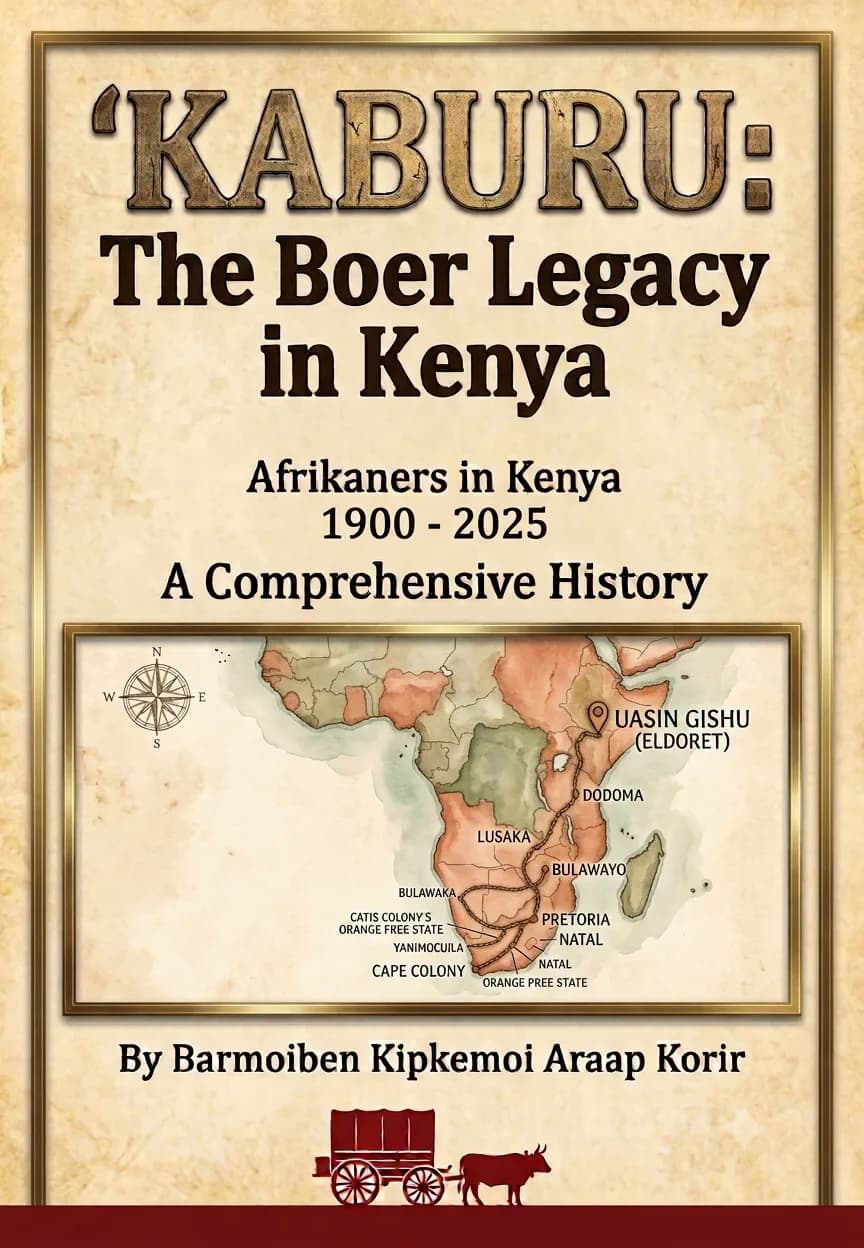
AFRIKANERS IN KENYA 1900-2025: KABURU — THE BOER LEGACY IN KENYA
They came as colonizers. They left as refugees. But they built a legacy that endures.
Between 1903 and 1969, a community of South African Boers, driven by the devastation of the Anglo-Boer War, trekked thousands of miles northward to establish a new homeland in East Africa. They built farms, churches, schools, and towns. They transformed a wilderness into a breadbasket. Then, swept away by African nationalism, they abandoned it all.
This is the definitive history of the Kaburu—the name the Kalenjin gave to the Boers. Drawing on decades of archival research, oral histories, and previously unpublished documents, Barmoiben Kipkemoi Araap Korir tells their story from the Anglo-Boer War to their enduring legacy in modern Kenya.
Inside You'll Discover:
- The Van Rensburg Trek of 1908, when nearly 300 souls crossed the Indian Ocean to settle the Uasin Gishu Plateau, and the Cloete Trek of 1911
- The bitter cultural wars against British assimilation and the fight to preserve the Afrikaans language and Calvinist faith
- The desperate years of poverty—hunting zebra for survival—and the eventual rise to wheat farming prosperity, producing nearly 70% of Kenya's wheat
- The "Reverse Trek" exodus of the 1960s, when families abandoned everything they had built over six decades
- How the "Kenyan Lesson" influenced the verligte movement, the collapse of apartheid theology, and F.W. de Klerk's historic decision to end white minority rule
- The enduring legacy—churches, schools, place names like Bayete and Bindura, and the Reformed Church of East Africa
- The remarkable story of Fanie Kruger, the last Kaburu still living in Kenya